

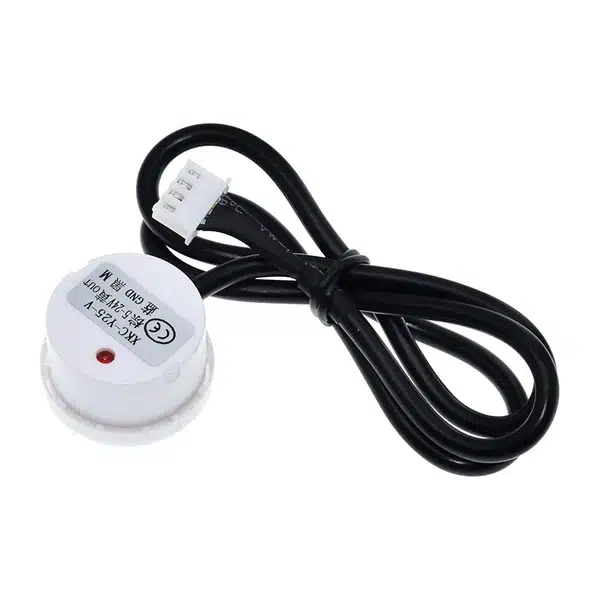
XKC-Y25-V Non-Contact Water Level Sensor 5-24V
Original price was: ₵85.00.₵80.00Current price is: ₵80.00.
The XKC-Y25-V Non-Contact Water Level Sensor detects liquid levels through plastic, glass and other non-metallic container walls without touching the water. Operating on 5-24V DC with a selectable high/low digital output, it is ideal for automatic water tank controllers, pump automation, overflow prevention and Arduino projects.
10 in stock
The XKC-Y25-V Non-Contact Water Level Sensor is an intelligent capacitive liquid detection sensor designed to monitor water levels without coming into direct contact with the liquid.
Unlike traditional float switches and conductive water sensors, the XKC-Y25-V is installed on the outside of a non-metallic container. It detects the presence or absence of liquid through the container wall, eliminating the need to drill holes or insert probes into the water.
This makes it an excellent solution for automatic water tank control, overflow detection, low-water protection, liquid monitoring and smart automation projects.
Key Features
- Non-Contact Detection: Detects liquid through non-metallic container walls without touching the water.
- Wide Operating Voltage: Works with a regulated 5-24V DC supply.
- Capacitive Sensing Technology: Detects changes in capacitance when liquid reaches the sensor position.
- Selectable Digital Output: Supports high/low signal output with configurable logic polarity.
- External Installation: Mounts outside the tank without drilling holes or modifying the container.
- Waterproof Sensor Housing: IP67 protection according to the XKC-Y25 series specification.
- Fast Detection: Approximately 500ms response time.
- LED Indicator: Built-in status indicator for convenient operation monitoring.
- Four-Wire Interface: Provides power, ground, signal output and operating-mode selection connections.
- No Moving Parts: Electronic detection without the mechanical components used in conventional float switches.
Technical Specifications
| Specification | Details |
|---|---|
| Model | XKC-Y25-V |
| Sensor Type | Non-Contact Capacitive Liquid Level Sensor |
| Operating Voltage | DC 5-24V |
| Current Consumption | Approximately 5mA |
| Output Type | Digital High/Low Level |
| High Output Level | Approximately Supply Voltage |
| Low Output Level | Approximately 0V |
| Response Time | Approximately 500ms |
| Maximum Sensing Wall Thickness | Up to 20mm |
| Level Detection Accuracy | ±1.5mm |
| Operating Temperature | -20°C to +105°C |
| Waterproof Rating | IP67 |
| Cable Length | Approximately 50cm |
| Sensor Diameter | Approximately 28mm |
| Sensor Height | Approximately 17mm |
| Connector | 4-Pin XH2.54-Type |
| Compatible Containers | Plastic, Glass, Ceramic and Other Suitable Non-Metallic Materials |
| Housing Colour | White |
Applications
1. Automatic Water Tank Level Control
Detect when water reaches a specified level inside a plastic storage tank without installing a sensor inside the water.
For an automatic tank-filling system, two XKC-Y25-V sensors can be installed at different heights:
- Lower sensor: Detects when the water falls below the minimum level.
- Upper sensor: Detects when the water reaches the maximum filling level.
A controller can use these two signals to start and stop a pump automatically.
2. Water Overflow Prevention
Install the sensor near the upper section of a water tank to detect when water reaches the maximum permitted level. The signal can activate an alarm or instruct a control circuit to stop filling.
3. Low-Water and Dry-Run Protection
Monitor the minimum water level in a reservoir or storage container. When the water drops below the selected sensing point, the sensor can provide a signal to a suitable controller for pump protection.
4. Arduino-Based Water Level Monitoring
Connect the sensor to an Arduino Uno R3 Development Board to build a programmable water level monitoring or automatic filling system.
The Arduino can interpret the sensor output and control external devices according to the programmed operating conditions.
5. Automatic Water Pump Control
Integrate the sensor into a water management system using a suitable relay or electronic motor driver.
For educational and small-scale automation projects, DIYGH stocks the 1-Channel 5V Relay Module and the 5V Mini Submersible Water Pump.
The sensor should provide a control signal to the switching circuit, not carry the pump’s operating current.
6. Liquid Monitoring and Automation
Suitable for monitoring liquid presence in compatible non-metallic reservoirs, small liquid-dispensing equipment, aquariums and automated water systems.
How the Non-Contact Sensor Works
The XKC-Y25-V operates using capacitive sensing technology.
When the container is empty at the sensing point, the sensor detects the electrical capacitance associated with the container wall and its surroundings.
As liquid rises to the sensor position, the capacitance changes. The internal electronics detect this change and switch the output signal.
Because detection takes place through the container wall, the sensor does not need to make physical contact with the water.
Important: One sensor detects liquid presence at its installation position. It does not continuously measure the total water depth or calculate tank volume.
Wiring Connections
The XKC-Y25-V uses a four-wire connection.
| Wire Colour | Function |
|---|---|
| Brown | VCC – Positive DC Supply |
| Blue | GND – Power Ground |
| Yellow | OUT – Digital Signal Output |
| Black | MODE – Output Logic Selection |
Output Mode Selection
The sensor allows its output logic to be selected using the black MODE wire.
MODE disconnected (floating):
- Liquid detected: HIGH output
- No liquid detected: LOW output
MODE connected to GND:
- Liquid detected: LOW output
- No liquid detected: HIGH output
This selectable output behaviour makes the sensor useful for different monitoring and automation applications.
Connecting to Arduino
For a typical 5V Arduino Uno application:
- Connect the brown wire to a regulated 5V supply.
- Connect the blue wire to GND.
- Connect the yellow output wire to a suitable digital input.
- Leave the black MODE wire disconnected or connect it to GND according to the required logic.
- Ensure the controller and sensor share a common ground.
- Test the HIGH and LOW readings with and without water behind the sensing surface.
When integrating the sensor with a 3.3V microcontroller such as ESP32, use a suitable signal-level interface. The sensor’s HIGH output may approach its supply voltage and must not be applied directly to a 3.3V-only GPIO.
Installation Guidelines
- Identify the desired high-water or low-water sensing position.
- Clean and dry the outside of the container.
- Position the sensing face firmly against the container wall.
- Secure the sensor using suitable adhesive or mounting material.
- Ensure no significant air gap exists between the sensor and container.
- Connect the power and output wiring.
- Test detection as the water rises and falls past the sensor position.
For reliable operation, install the sensor on a suitable non-metallic surface and check that the wall thickness is within the sensor’s supported sensing capability.
Important Usage Information
- Do not install the sensor behind a metal container wall.
- Use a regulated DC power supply within the 5-24V range.
- Do not connect the sensor output directly to a water pump or other high-power load.
- Use a suitable relay, motor driver or controller for pump switching.
- Match the output voltage to the connected controller’s input requirements.
- Verify correct wiring and detection behaviour before commissioning an automatic pump system.
- Use independent overflow protection where a sensor failure could cause damage.
Package Includes
- 1 x XKC-Y25-V Non-Contact Water Level Sensor with Attached Cable and 4-Pin Connector
Available from DIYGH Tech Hub, Apatrapa Junction, Kumasi, Ghana, for water level monitoring, automatic tank controllers, Arduino automation and STEM projects.
For detailed model specifications and signal connections, see the XKC-Y25 Manufacturer Technical Documentation.
Related products
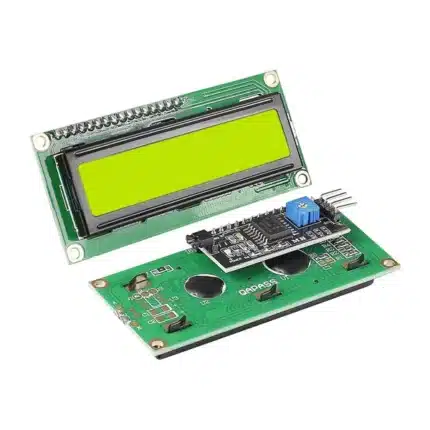
16×2 LCD Display with I2C Interface – Yellow Backlight
A clear, beginner-friendly 16×2 character display with the I2C backpack already soldered. The yellow-green backlight provides excellent readability while the I2C interface reduces wiring to only four connections.
Display: 16 characters × 2 lines
Backlight: Yellow-Green
Interface: I2C (VCC, GND, SDA, SCL)
Voltage: 5V DC
Contrast: Adjustable
Installation: Ready to use – no backpack soldering required
Best For: Arduino, ESP32, Raspberry Pi, IoT and educational projects

20×4 LCD Display Module (Blue Backlight) | 2004A Character Screen
Double the space, double the data. The standard 16x2 LCD is great, but sometimes you need more room. The 20x4 LCD gives you 4 lines of text (20 characters per line), allowing you to display complex menus, sensor readings, and status messages all at once.
-
Size: 20 Characters x 4 Lines.
-
Display: White Text on Blue Background.
-
Controller: HD44780 (Standard Industry Chip).
- Best For: Weather Stations, 3D Printers, and Advanced Menus.
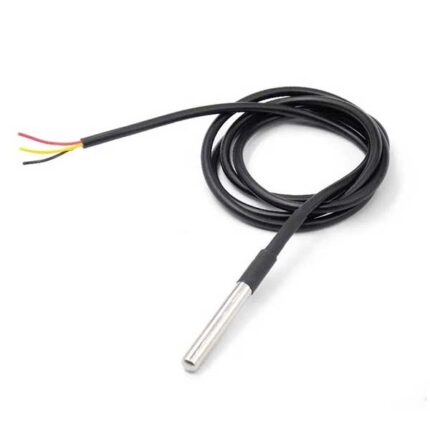
DS18B20 Waterproof Temperature Sensor Probe | Stainless Steel Digital Thermometer
Measure liquid temperature with digital precision. This is the waterproof version of the famous DS18B20 sensor. Encased in a stainless steel tube, it is perfect for measuring water, soil, or air temperature in harsh environments.
-
Range: -55°C to +125°C
-
Interface: 1-Wire Digital (Requires only 1 pin)
-
Cable Length: 1 Meter
-
Best For: Aquariums, boilers, soil temperature, and cold chain monitoring.
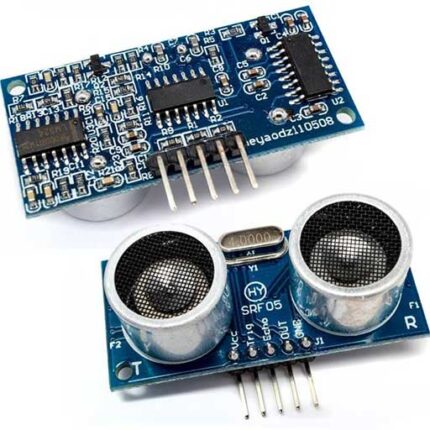
HC-SR04 Ultrasonic Sensor Module | Distance Measurement for Arduino
Give your robot eyes. The HC-SR04 uses sonar (sound waves) to measure distance, just like a bat. It is the standard sensor for obstacle avoidance robots and water level monitoring systems.
-
Range: 2cm to 400cm (4 Meters)
-
Accuracy: 3mm
-
Pins: VCC, Trig, Echo, GND
-
Best For: Obstacle avoiding cars, reverse parking sensors, and tank level detection.
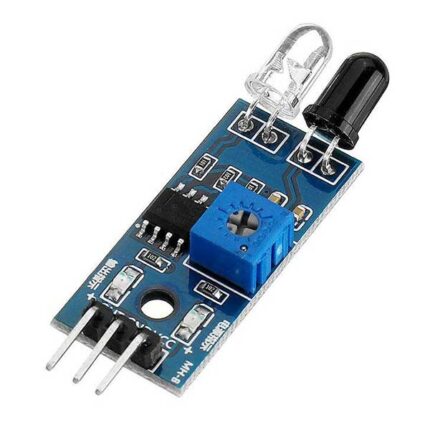
IR Infrared Obstacle Avoidance Sensor Module | FC-51 for Arduino
Teach your robot to see. This sensor emits infrared light and detects reflections to see if an object is in front of it. It is the essential component for building "Obstacle Avoiding Robots" and simple security alarms.
-
Detection Range: 2cm - 30cm (Adjustable).
-
Output: Digital Signal (LOW when obstacle detected).
-
Compatibility: Works directly with Arduino, ESP32, and Raspberry Pi.
-
Best For: Robot Cars, Smart Trash Cans, and Proximity Alarms.

IRF520 MOSFET Driver Module (0-24V) | PWM Motor & LED Controller
The easiest way to drive 12V/24V loads. This breakout board allows your Arduino to control high-voltage devices like LED strips, DC motors, and solenoid valves using the IRF520 MOSFET. It features screw terminals for easy wiring—no soldering required!
-
Max Load: 24V DC / < 5A.
-
Control Voltage: 3.3V or 5V (PWM Compatible).
-
Output: Pulse Width Modulation (Speed/Dimming control).
-
Best For: LED Strips, Small DC Fans, and Solenoids.

NEO-6M GPS Module V2 with Ceramic Antenna | Flight Controller & Tracker
Add Satellite Navigation to your project. This high-precision GPS module allows your Arduino, ESP32, or Drone to know its exact location, speed, and time. It comes with a detachable ceramic antenna and a built-in backup battery for fast "Hot Starts."
-
Chipset: U-Blox NEO-6M.
-
Antenna: High-gain Active Ceramic Antenna (Included).
-
Data Retention: EEPROM + Battery (Saves configuration).
-
Best For: Drone Flight Controllers, Vehicle Trackers, and Speedometers.

Reviews
There are no reviews yet.